Venous insufficiency is a disease in where the flow of blood through the veins is insufficient, making blood to pool in the legs.
What causes chronic venous insufficiency?
The commonest causes of venous insufficiency are earlier instances of varicose veins and blood clots.
Symptoms of Venous Insufficiency
- Inflammation of ankles and legs (edema)
- Pain which worsens when you stand and gets better when you lift your legs
- Leg cramps
- throbbing, aching, or a feeling of heaviness in your legs
- Itchy legs
- Weak legs
- Thickening of the skin on your ankles or legs
- Skin which is changing color, particularly around the ankles
- Leg ulcers
- Varicose veins
- a feeling of tightness in your calves
Who is affected by chronic venous insufficiency?
Approximately 40 % of people in America have chronic venous insufficiency. It takes place more often in those over age fifty, and more frequently in women compared to men.
How is CVI chronic venous insufficiency diagnosed?
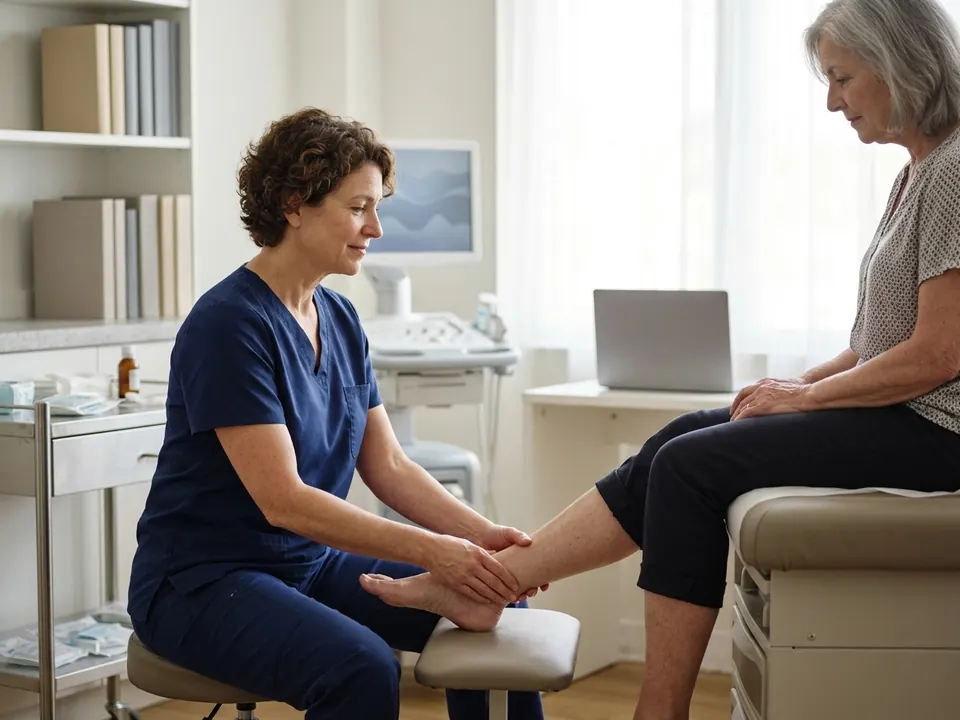
To diagnose CVI, your physician will carry out a physical examination and a whole medical history whole. During the physical examination, the physician will carefully analyze your legs.
A test known as a vascular or duplex ultrasound might be used to check out the flow of blood in your legs. During the vascular ultrasound, a transducer (small hand-held gadget) is placed on the skin over the vein to be assessed. The transducer discharges sound waves, which bounce off the vein. These sound waves are recorded, and a picture of the vessel is made and shown on a monitor.
Risk factors for CVI
- Blood clots
- Varicose veins
- Obesity
- Pregnancy
- Deep vein thrombosis (DVT)
- Smoking
- Cancer
- Trauma, muscle weakness, leg injury
- Inflammation of a superficial vein (phlebitis)
- Family history of venous insufficiency
- Inactivity(standing or sitting for long periods of time without moving can result in high blood pressure in the leg veins and raise your risk)
How is chronic venous CVI managed or treated?
- Avoid long periods of sitting or standing
- Exercise frequently
- Lose weight
- Lift up your legs while lying and sitting down
- Put on compression stockings
- Take antibiotics as needed to treat skin infections.
- Practice good skin hygiene.
Nonsurgical Treatment
Nonsurgical treatments are sclerotherapy and endovenous thermal ablation.
Sclerotherapy entails the injection of a solution straight into spider veins or small varicose veins, which makes them collapse and vanish. Sclerotherapy may be done in the doctor’s office. Sclerotherapy may get rid of the discomfort and pain of these veins helping to prevent complications like ulceration and venous hemorrhage. It's also often done for cosmetic reasons.
Endovenous thermal ablation is a more recent procedure, which uses a laser or high-frequency radio waves to produce intense local heat in the affected vein. This treatment shuts off the problem veins; however, leaves them in place so there is very little bruising and bleeding.
Surgical Treatments
When is surgical treatment needed?
Ligation and stripping usually are done in combination. Vein ligation is a technique where vascular surgeon cuts and ties off the problem veins. Many patients recover in a couple of days and may get back to their normal activities. Stripping is the surgical removal of bigger veins through two small incisions. Stripping is usually a more extensive treatment and might need up to ten days for recovery. It often leads to bruising for several weeks after surgery.
Microincision/ambulatory phlebectomy is a minimally invasive treatment where needle punctures or small incisions are made over the veins, and a phlebectomy hook is utilized to take out the problem veins.
Vein bypass in the leg resembles heart bypass surgery, though in a different place. Bypass is utilized for treating chronic venous insufficiency in the upper thigh and only in the most extreme situations when no other treatment is effective.
Can CVI venous be prevented?
- Eat a healthy balanced diet.
- Stop smoking.
- Exercise frequently.
- Avoid putting on restrictive clothing like belts or tight girdles.
- Lose weight if you're obese.
- Avoid lengthy periods of standing or sitting
 Private Hospital
 JCI
 ISO