At a glance
Key planning information for cryo-preservation for embryos in Jordan.
0 hospitalsList cryo-preservation for embryos
Cryo-Preservation for Embryos in Jordan is priced per case. Each hospital quotes its own price for your case.
Hospitals and clinics offering Cryo-Preservation for Embryos in Jordan
The order reshuffles every hour so each gets equal exposure.
No hospitals are listed here yet.
Description of Cryo-Preservation for Embryos:
What is Cryo-Preservation for Embryos?
Cryo-preservation for embryos, also known as embryo storage or embryo freezing, is a procedure for the storage of embryos. Cryo-preservation is used in IVF when more embryos than currently needed are produced. The process preserves embryos through cooling to sub-zero temperatures, which stops the biological activity that leads to cell death. The embryos are taken out of storage in a later treatment cycle for transfer into the uterus. Frozen embryos can also be donated.
Cryo-preservation for embryos, also known as embryo storage or embryo freezing, is a procedure for the storage of embryos. Cryo-preservation is used in IVF when more embryos than currently needed are produced. The process preserves embryos through cooling to sub-zero temperatures, which stops the biological activity that leads to cell death. The embryos are taken out of storage in a later treatment cycle for transfer into the uterus. Frozen embryos can also be donated.
How is Cryo-Preservation for Embryos carried out?
Who is a suitable candidate for Cryo-Preservation for Embryos?
What are the chances of success of Embryos Cryo-Preservation?
Some experts claim that the chances of having a baby are lower with frozen embryos than with fresh embryos. Others claim there is no difference in the chances of success between these two methods. According to the Human Fertilisation and Embryology Authority (HFEA), not every embryo survives the cryo-preservation process and there is a survival rate of around 75 to 80 percent.
What are the ethical considerations for Cryo-Preservation for Embryos?
Patients consider how long their embryos should be stored, what will happen to the embryos should the patient or her partner die or if the couple divorces, and whether the embryos may be donated to infertile couples if they are not needed by the patient. The patient who provided the eggs or the partner who provided the sperm may withdraw consent for the embryos to be used, at any time during the cryo-preservation procedure.
- Embryos are frozen at any stage of the IVF incubation period.
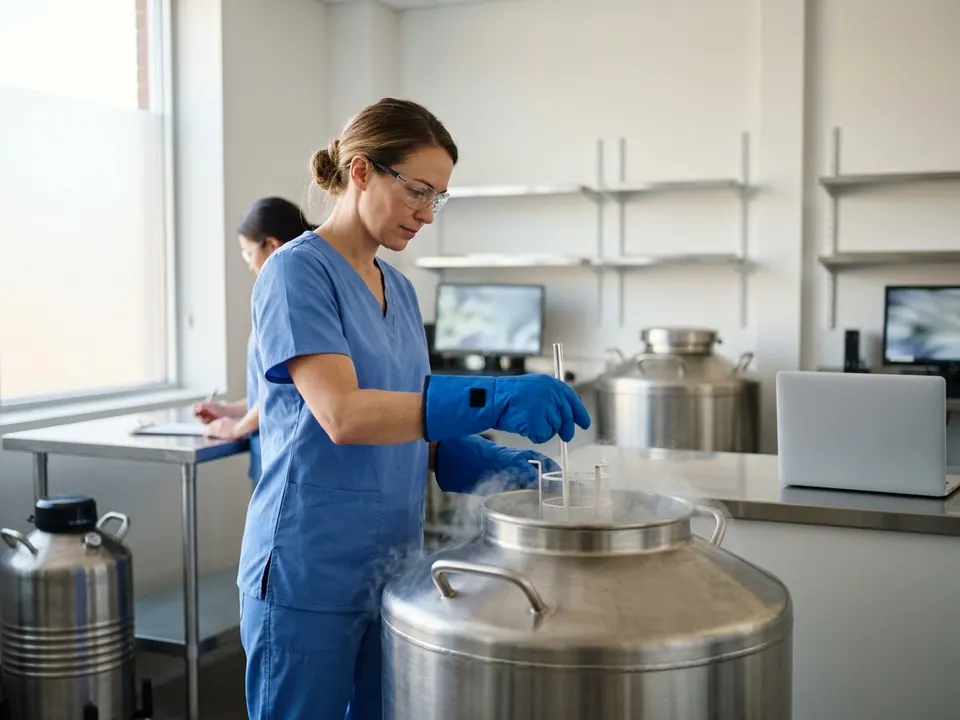
- The embryo is protected and stored in liquid nitrogen at a very low sub-zero temperature.
- The embryo is thawed by removing it from the liquid nitrogen and keeping it at room temperature, then storing it in an incubator before transfer.
- The transfer of a cryo-preserved embryo to the uterus is carried out during a natural cycle, a cycle using hormone replacement or a stimulated cycle.
Who is a suitable candidate for Cryo-Preservation for Embryos?
- Women at risk of developing severe ovarian hyperstimulation syndrome after IVF treatment.
- Women whose IVF treatment is stopped due to a bad reaction to fertility drugs or illness near the time of transfer.
- Women who wish to donate embryos to other women.
- Cryo-preservation for embryos can also used to preserve embryos before treatment for cancer – chemotherapy or radiotherapy.
What are the chances of success of Embryos Cryo-Preservation?
Some experts claim that the chances of having a baby are lower with frozen embryos than with fresh embryos. Others claim there is no difference in the chances of success between these two methods. According to the Human Fertilisation and Embryology Authority (HFEA), not every embryo survives the cryo-preservation process and there is a survival rate of around 75 to 80 percent.
What are the ethical considerations for Cryo-Preservation for Embryos?
Patients consider how long their embryos should be stored, what will happen to the embryos should the patient or her partner die or if the couple divorces, and whether the embryos may be donated to infertile couples if they are not needed by the patient. The patient who provided the eggs or the partner who provided the sperm may withdraw consent for the embryos to be used, at any time during the cryo-preservation procedure.
About Cryo-Preservation for Embryos
Key facts to plan your treatment: how long it takes, your hospital stay, anaesthesia, risks and recovery.
Days admitted
None – the IVF and cryo-preservation procedure doesn’t require a hospital stay.
Anesthesia
Egg collection in IVF may be carried out under sedation but generally no anesthesia is used in IVF or in the cryo-preservation procedure.
Recovery
There is no recovery period following cryo-preservation for embryos. With IVF you may rest for a short period after egg collection and egg implantation.
Risks
- Not every embryo will survive the freezing process.
- With IVF in general, you may experience a bad reaction to fertility drugs or cramps following egg collection.
- There is a risk of multiple births following IVF using frozen embryos but the risk is lower than with IVF using fresh embryos.
After care
- Ease cramps after egg collection in IVF with pain killers.
- Report any side effects from fertility drugs to your doctor.
Patient reviews
Reviews coming soon.
Common questions
Frequently asked questions
Have a question? Get a free consultation.