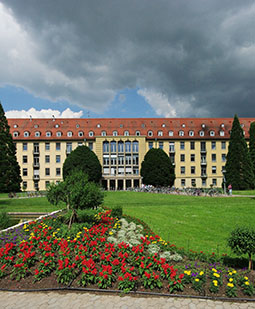
The University Medical Center Freiburg is one of the largest medical facilities in Europe and part of the Albert Ludwigs University Freiburg, one of five outstanding centers of academic excellency in Germany.
DoctorsLBProf. Leena Bruckner-tudermanTJProf. Thilo JakobView all 3
One of Germany's largest hospitals, made up of more than 50 clinics and specialist institutes spanning all medical specialties. Kinikum Stuttgart is regarded as one of the best hospitals in Germany, and is a referral center for oncology, ENT, pediatrics and more.
DoctorsMTDr. M.-c. ThodeJRDr. J. Rieker-SchwienbacherView all 7
This is an uncommon chronic condition characterized by the hard thick skin. In severe cases, it affects the internal organs and blood vessels of the body.
Causes of scleroderma
Scleroderma results from the immune system attacking the tissue under the skin and around blood vessels and internal organs. This causes thickening and scarring of the tissue in the affected areas.
Types of scleroderma
Localized scleroderma: This is the mild form of the condition and it just affects the skin. Localized scleroderma can be further classified depending on exactly how it affects the skin.
Morphoea: This is characterized by oval patches on the skin that are discolored, and are usually itchy. The patches may be hairless and shiny and may improve after a few years.
Linear: This is characterized by thickened skin which occurs in lines along the legs, arms, face or scalp. In some cases, it affects the underlying muscle and bone. It may cause permanent problems like shortened limbs.
Systemic sclerosis
This form of the condition is more serious and can affect the skin and internal organs. It is further classified into:
Limited cutaneous systemic sclerosis: This mainly affects the face, hands and arms. It is characterized by the deposition of calcium nodules on the skin (calcinosis), exaggerated vasoconstriction in the hands( Raynaud's phenomenon), difficulty swallowing( esophageal dysfunction),thickening of the skin in fingers(sclerodactyly), dilated capillaries on hands, face and mucous membranes(telangiectasias).
Diffuse systemic sclerosis: This form progresses rapidly and affects the skin and internal organs such as the heart, lungs, kidneys and esophagus.

 University Hospital
 ISOPrice on request